The Blanket Fort Series Ch. 2
Building a done point that holds
Dear Parent,
Last week, we looked at why stopping is so hard — the slot machine psychology, the variable rewards, the way a developing brain genuinely can't just "choose" to disengage from a compulsion loop.
This chapter is entirely about what to do about it.
No repeated science. No re-explaining the loop. Just the practical architecture of a done point that actually holds — the specific language, the age-by-age strategy, and what to do in the moments when it still falls apart (because sometimes it will).
Let's build it.
A Quick Recap Before We Build
Last week, we covered why stopping is so hard. The short version, if you missed it:
Apps and games built on compulsion loops borrow directly from casino psychology. The variable reward is not knowing if the next video, level, or loot box will be the good one and keeps the brain in a state of heightened anticipation. It can't relax. It can't disengage. And when the screen goes off mid-loop, the brain experiences something genuinely similar to withdrawal. That's not weak willpower. That's neurochemistry.
That's the problem. This chapter offers solutions.
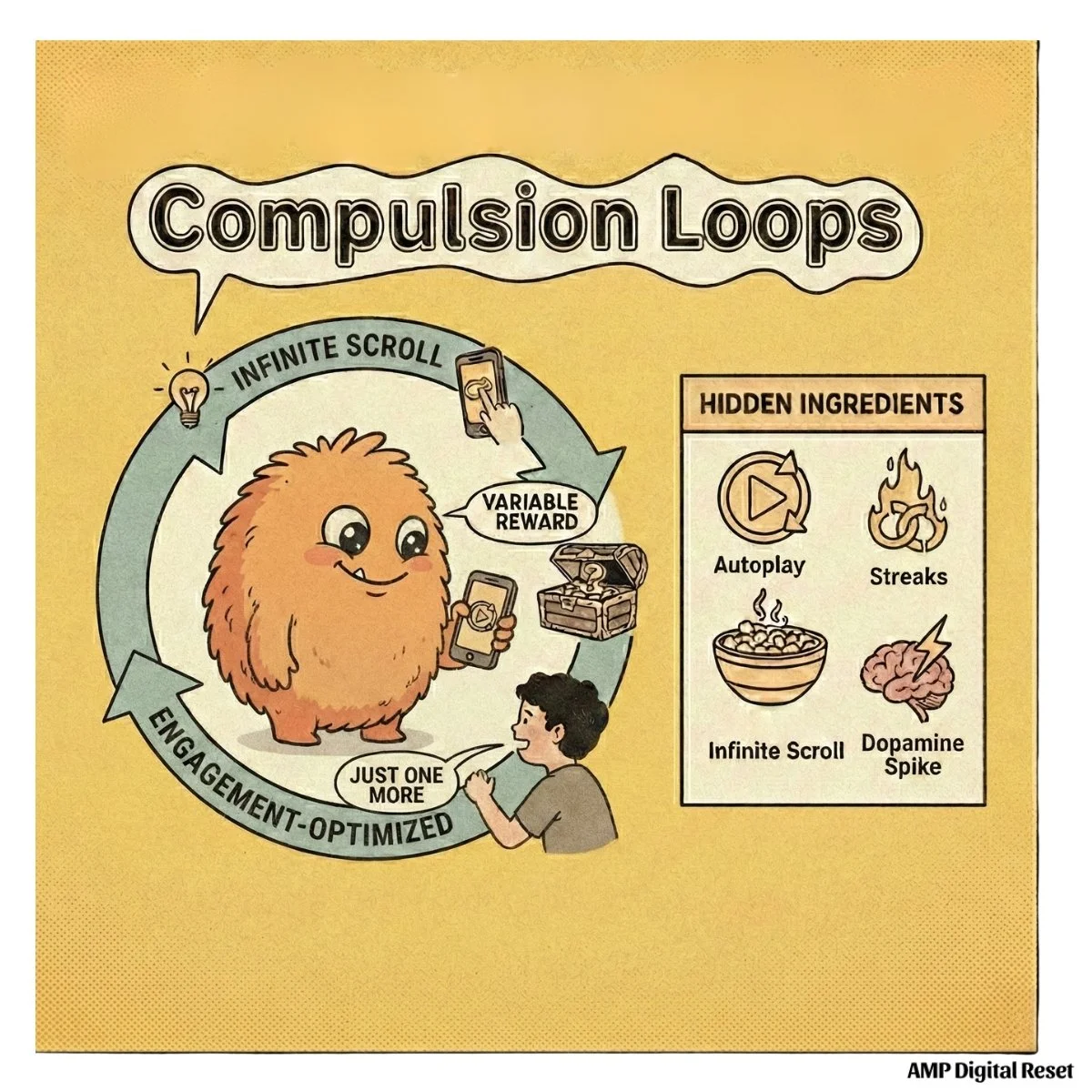
One Distinction That Changes Everything
Most parents try to end screen time during the session. They walk into the room, announce that it's time to stop, and brace for impact.
This is structurally the same as walking onto a casino floor, watching someone pull the slot machine lever, and saying, "Okay, you’re." The loop hasn’t been completed, and the brain is anticipating a completion to the loop. The announcement lands as an ambush, not a transition.
It's not about being stricter. It's about building the stopping cue into the structure before the compulsion loop has a chance to start.
Setting the Done Point: Before the Screen Comes On
When you sit down together before the session starts, you're doing two things at once. You're establishing a predictable end, which the brain can actually prepare for, and you're making your child a participant in the structure rather than a subject of it. That matters more than it sounds.
The done point needs three qualities to hold:
It must be visible - something your child can see or track themselves (a timer on the counter, not just a time in your head).
It must be concrete- "two episodes" or "when the timer dings," not "in a little while."
It must be agreed on in advance and named out loud before anyone presses play.

Done Points for Different Ages
Done points aren't one-size-fits-all. A visual sand timer works beautifully for a four-year-old and feels condescending to a ten-year-old. Here's what tends to work at each stage:
Ages 2–4 - At this age, abstract time means nothing. Make it sensory and concrete.
"When the timer sings, we park the tablet."
"Two episodes, then snack time."
A visual sand timer that they can watch count down is more effective than a digital clock.
Ages 5–7 - They're starting to understand sequence and fairness. Let them be part of setting it.
"We stop at the end of this episode."
"When the timer dings, we switch to outside time."
Let them press start on the timer — ownership reduces resistance at the end.
Ages 8–10 - They can negotiate, and they will. Give them real input within real limits.
"Two rounds, then we close it."
"You have 30 minutes — you choose how to use it, but the timer is non-negotiable."
Build in the activity they transition to, not just the screen turning off.
Ages 11+ - The goal starts shifting from external structure to internal awareness.
"Set your own timer and honour it."
"You have 45 minutes. What you do with it is your call."
Natural consequences: "If you can't stop when agreed, we take a break from this app." — and follow through consistently.
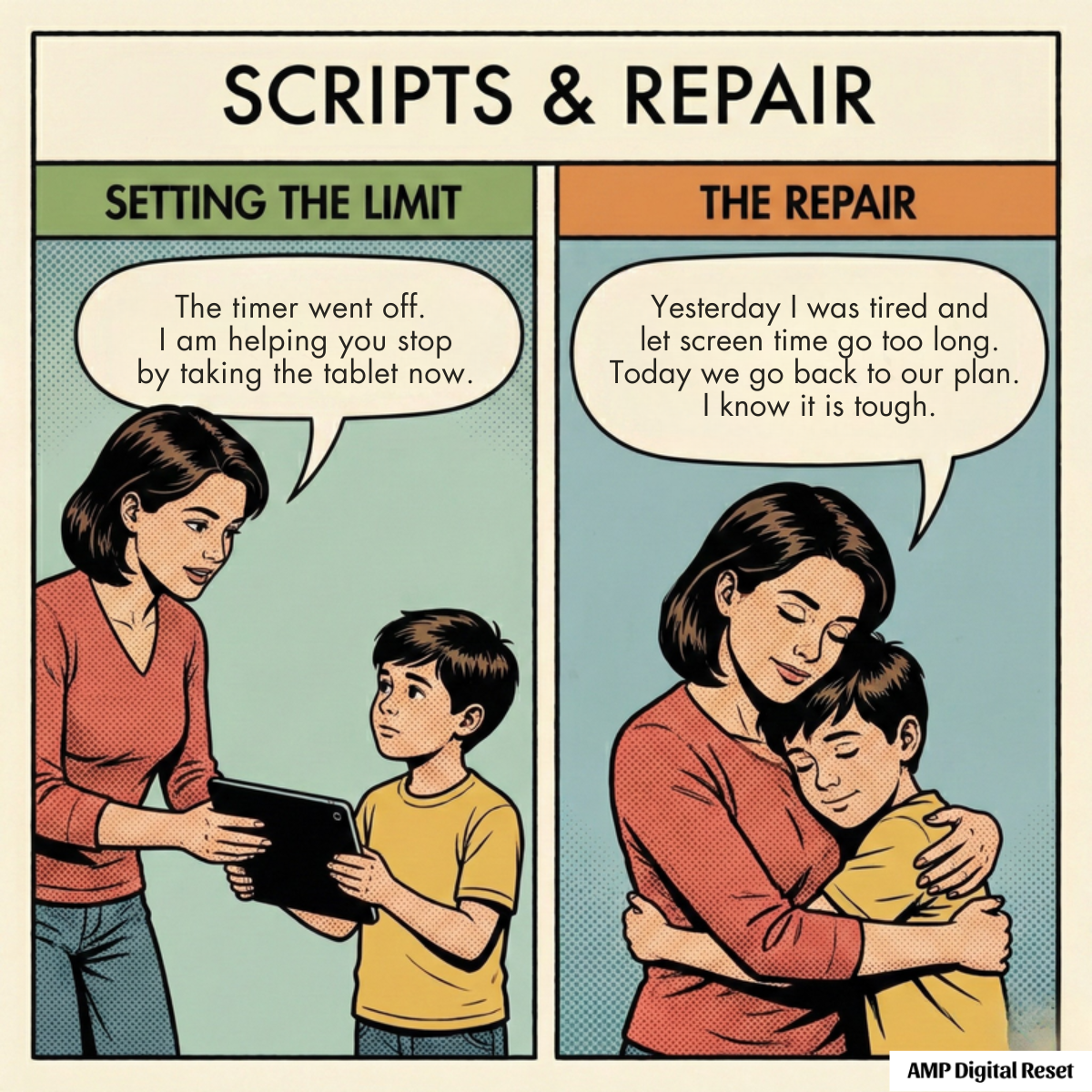
The Script
When the done point arrives, the words matter almost as much as the structure. These are calm, repeatable, and non-negotiable:
"I won't let infinite scroll take over your brain today. I know you want more. It's okay to be upset. We're still done."
For younger kids who need more context:
"This app is built like chips with a fishhook — your brain will want just one more. So we chose a done point before we started. The timer went off. We're done."
For moments when they're genuinely distressed:
"I know you're upset. Your brain was waiting for another hit of fun and didn't get it. That's exactly how this app is designed to work. Let's help your brain calm down."
What these scripts don't do: they don't negotiate, they don't threaten, and they don't shame. They name what's happening and hold the line.
Help the Brain Cross the Bridge
Stopping is only half the job. The other half is helping the nervous system land somewhere safe — because a brain coming off a compulsion loop is genuinely dysregulated, not just annoyed.
Have the transition ready before the screen goes off:
Water or a snack (blood sugar and hydration do real work here)
Movement: jumping jacks, dancing, a short run, dance party
Sensory play: LEGO, playdough, kinetic sand, anything tactile
Music
Physical connection: a hug, sitting together, anything that signals safety
Pro tip: The boredom basket is within arm's reach, the water bottle is already filled, and the outdoor shoes are already by the door. The transition is easier when it's already set up.
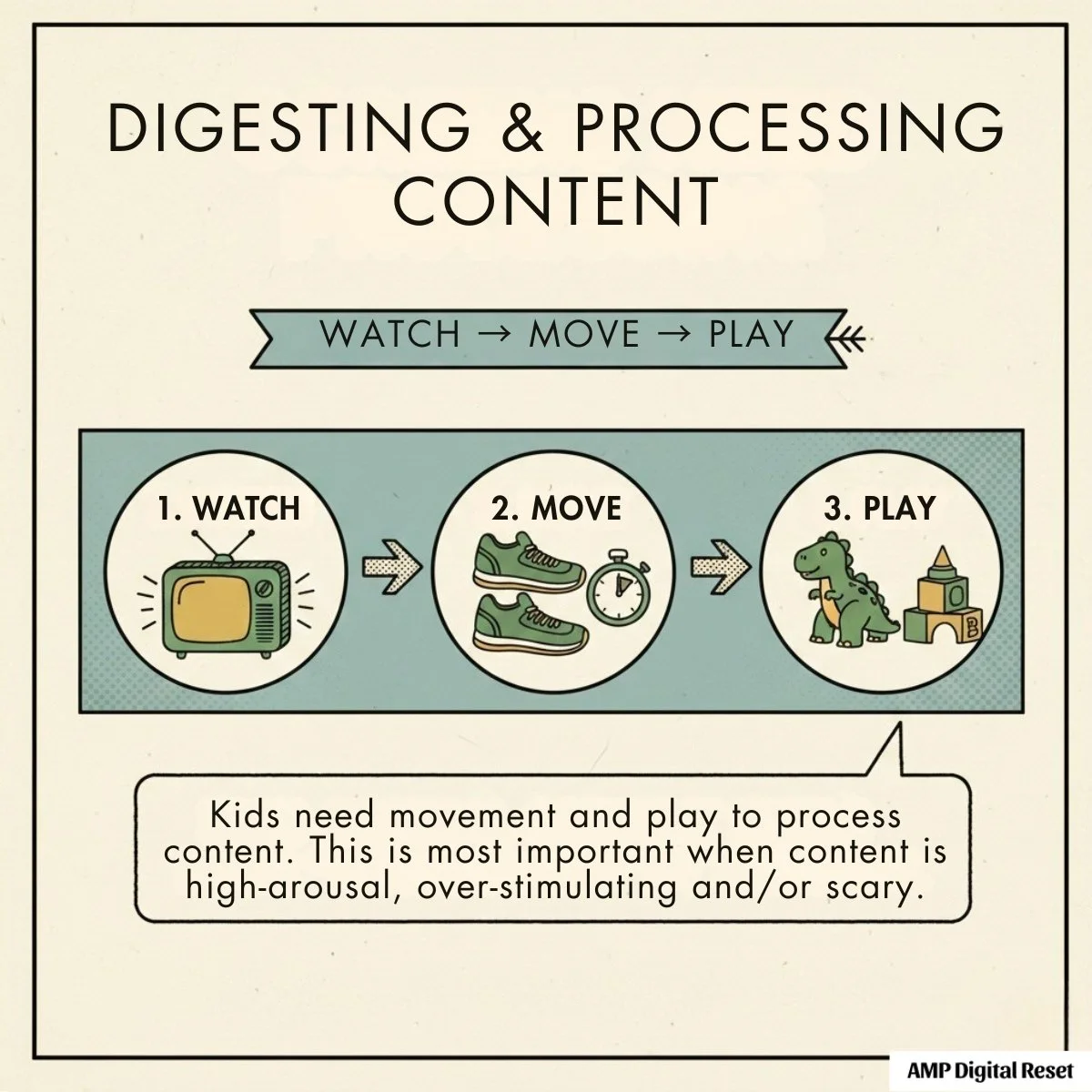
Watch → Move → Play
The simplest framework for what happens after screens end:
Children can seem completely fine during a show and then melt down the moment it ends. Their bodies are still processing what they absorbed from the pace, the stimulation, the interrupted anticipation. Movement and play are how they digest it. This matters most after high-action content, anything scary or intense, cliffhangers, and anything in the compulsion-loop category.
Troubleshooting: When Things Still Fall Apart
They will. Especially the first few times. A brain that's been getting its done point changed mid-session for months doesn't adapt to a new structure overnight.
Hold the boundary: "I know you're upset. We're still done.
"Name the feeling: "You're really disappointed. You wanted to keep going.
"Offer the bridge: "Let's get some water and go outside."
Don't negotiate: Negotiating teaches them that melting down works. It will happen more, not less.
Validate later, when everyone is calm: "That was hard. Screen time is designed to be hard to stop. That's exactly why we need the done point."
After three to five consistent experiences with the same structure, the brain learns the new pattern. Yours does too.
The Bottom Line
When screen time boundaries hold, something important happens. Your child learns that the loop isn’t endless, the screens have edges and that the grown-up in the room is steadier than the algorithm.
That's not a small thing. In a media environment engineered to never stop, this might be one of the most useful lessons we can give our kids.
Stay tuned next week for Chapter 3: Not All Streaming Is Created Equal: YouTube, Platforms, and the AI Problem