Live from the Blanket Fort
A Real Parent's Guide to Screen Time Without the Meltdowns
Dear Parent,
This guide was created for parents who look forward to watching cartoons in their pyjamas from a blanket fort. It's for parents who know that sometimes we need to give ourselves a time-out because we're exhausted and irritable... and a few episodes of Bluey are better than snapping at our kids.
This is also for parents who want to understand how different types of content impact developing minds, so we can prevent long-term issues and the short-term nightmare of epic meltdowns when screen time ends.
Screen Time is Like Food
Some screen time is like soup: cozy, nourishing, and it can improve the whole vibe in the house.
Some screen time is like chips: enjoyable until it becomes a recurring negotiation.
Some screen time is like neon-blue mystery slush: exciting at first, but it leads to chaos and meltdowns when the high crashes down.
This guide provides quick labels, calm scripts, and high-impact/low-effort strategies to help build safer, more meaningful screen time.
The 3 Levers
What if managing screen time was less about rules and more about understanding? That's exactly what the 3 Levers are for.
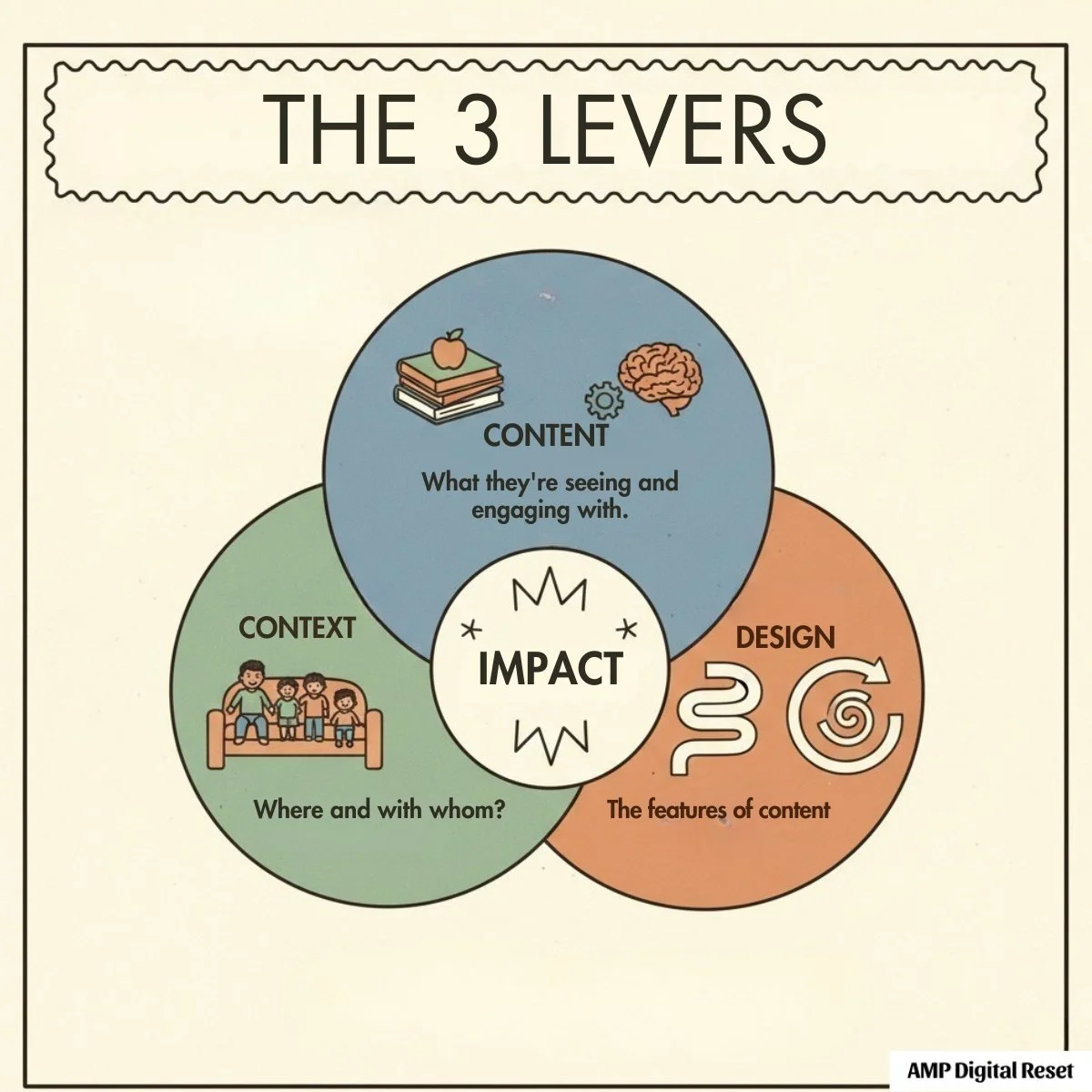
1. CONTENT: What are they consuming?
Not all screen time affects the brain the same way.
2. CONTEXT: Where and with whom?
Side-by-side interactions beat solo. Shared spaces beat bedrooms. Adult presence changes everything.
3. DESIGN: Does it have an end, or does it hook?
Features like autoplay, infinite scroll, and streaks aren't neutral. They're designed to keep users hooked, and they work on adult brains too.
Screen Time Nutrition Labels
What if you could read a screen the way you read a nutrition label? That's exactly the idea behind Screen Time Nutrition Labels: discern and label first, then decide on portions.
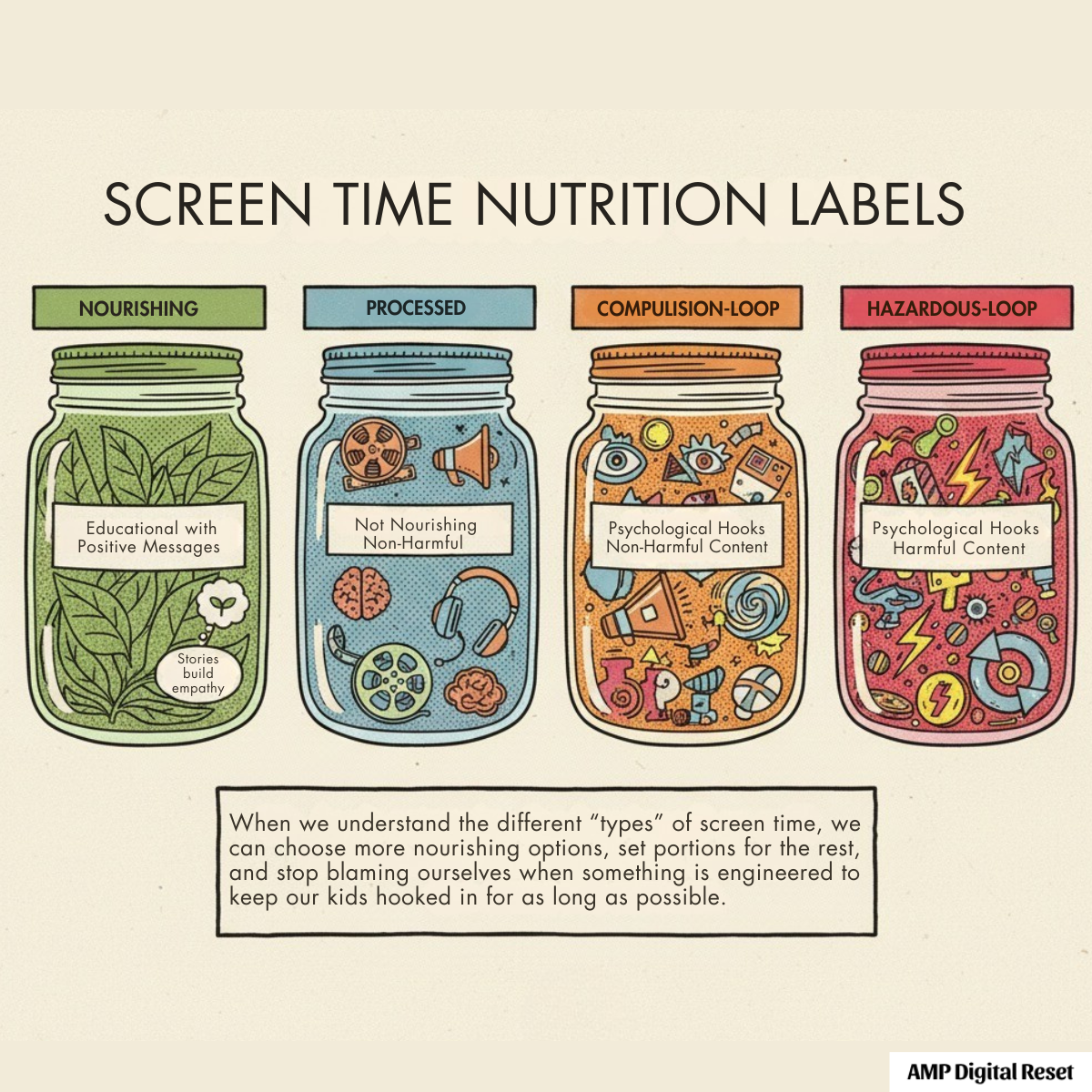
🟢 NOURISHING
What it is: Creative, educational, connecting, pro-social. Often easier to stop. This is our Saturday morning cartoon equivalent. It’s the stuff that feels good before, during, and after.
Examples:
Educational shows with clear narrative arcs: Bluey, Daniel Tiger, Sesame Street, Cyberchase, Nature Shows, Wild Kratts
PBS Kids content generally (no ads, no algorithm, no autoplay rabbit holes). Often created by teams of educators.
Nature documentaries co-viewed with a parent (Planet Earth, Our Planet)
Video calls with grandparents, cousins, pen pals, especially when there's a shared activity like drawing together
Creative tools: Procreate for kids, GarageBand, stop-motion apps, Scratch Jr.
Goal-oriented learning apps with natural stopping points: Typing Club, Khan Academy Kids, Duolingo ABC
Co-op games with clear endpoints where kids play alongside (not against) a parent
Many cartoons from the 80s and 90s are not engineered to hook in viewers and are easier to stop without meltdowns.
Portion guidance: Generous. These build skills, emotional literacy, and real-world connections.
🔵 PROCESSED
What it is: Not deeply nourishing, not harmful. Needs structure and portioning. Can leave kids dysregulated, especially when they're tired, hungry, lonely, or having an off day.
Examples:
High-stimulus cartoons that are entertaining but not building much: SpongeBob, The Loud House, Teen Titans Go! Paw Patrol
Most popular kid movies and general streaming content
Minecraft in creative mode (lower stakes than survival or multiplayer)
Mario Kart, Mario Party, and similar Nintendo titles. These are genuinely fun, but "one more race" is a real loop
Unboxing channels and kid reaction content on YouTube Kids (entertaining, limited nutritional value)
Portion guidance: Set clear time limits. Use timers. Follow with movement and play.
Watch for: Dysregulation at transition times. If our kids are crankier after watching, it's a sign this content is harder for them to digest.
🟠 COMPULSION-LOOP
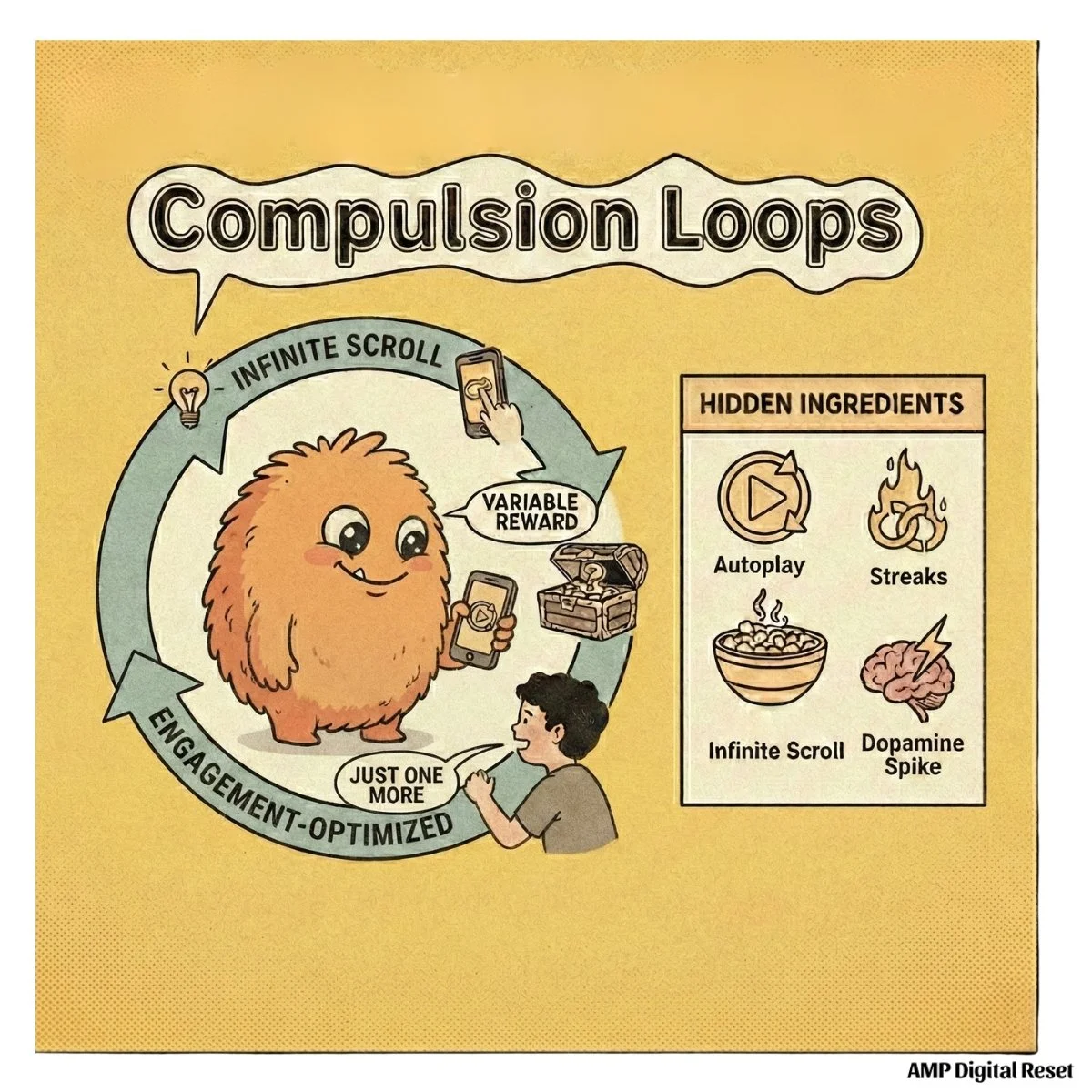
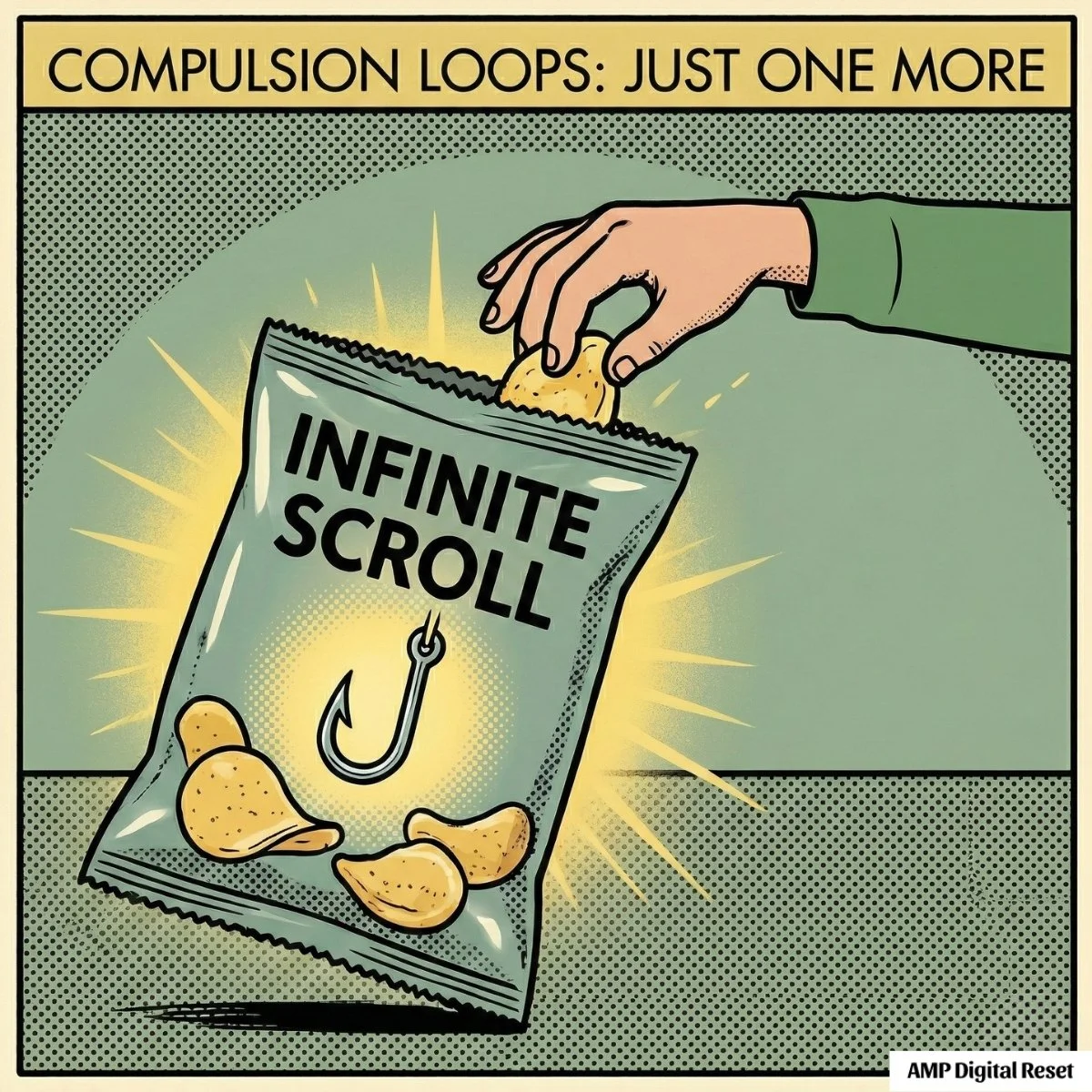
What it is: This content is hard to stop due to design and business models. Many platforms use sophisticated techniques (borrowed directly from casino psychology) to keep users engaged. Features like infinite scroll and autoplay maximize time on the platform. These aren't side effects of the design. They are the intentional design.
Examples:
YouTube (algorithm-driven, autoplay, constant novelty)
YouTube Shorts (this format is significantly more difficult to stop than long-form)
Minecraft survival mode and multiplayer servers (progression systems, social pressure, no natural end)
Fortnite, Among Us, Fall Guys. These feature variable outcomes every round, and social peer pressure is built in
Roblox, especially with its in-game economy and social elements
Gacha games disguised as anime, puzzle games, or kids' titles. The loot-pull mechanic is a pure slot machine
Hypercasual games like Stumble Guys or Subway Surfers are engineered for the one-more-run loop
Many free-to-play mobile games with in-app purchases
Apps with "streaks" or daily login bonuses. This is classic operant conditioning
Snapchat streaks where streaks and social approval are combined as the variable reward
Social media feeds of any kind, especially Instagram and TikTok
Hidden ingredients to watch for:
Autoplay (no natural stopping cues)
Infinite scroll (no "done" point ever)
Streaks (fear of losing progress)
Variable rewards (slot-machine effect)
Loot boxes and random rewards
Daily login bonuses that punish absence
Constant novelty (big feelings, quick hits, immediate next thing)
Portion guidance: Restricted or avoided for young kids. If allowed, requires adult-set "done points", parental controls for safety, and co-viewing.
🔴 HAZARDOUS-LOOP
What it is: When platforms designed to hook us also contain misinformation, disinformation, or genuinely disturbing material, the psychological impact can be significant. The hook keeps kids in contact with harmful content longer than they'd ever choose to be. Sometimes disturbing content creates a hook because kids are naturally curious and want to understand what they are seeing.
Examples:
Unsupervised YouTube - algorithms can pull kids from Bluey to something deeply disturbing in a few clicks. If you would like more information on this, you can see the YouTube section below.
Apps, platforms and social media with user-generated content. Moderators cannot keep up with the flood of AI slop right now.
Unsupervised Discord servers featuring unmoderated content, combined with real social bonds. Cases of inappropriate interactions with strangers are ongoing.
Violent or age-inappropriate games. Single-shooter games are the most addictive format for video games.
Any platform combining psychological hooks with harmful material
Instagram, Facebook, Snapchat, TikTok, etc., have repeatedly faced legal issues due to their inability to protect kids from disturbing people and content. Their “safety” features continue to fail, and kids will see violence, dead bodies, nudity and graphic content that is upsetting for adults. Cases of inappropriate interactions with strangers are ongoing.
Portion guidance: Eliminate. There is no safe portion.
The Compulsion Loop Problem
Here's the science behind why some screens are so hard to put down.
1. Persuasive technology floods the brain with "keep going" signals
Many games and cartoons incorporate rapid scene changes, constant novelty, and frequent mini-rewards. Dopamine spikes trigger the brain to keep reaching for more.
Basically: "Ooh, that felt good… do it again."
2. Variable rewards (unpredictable) are especially sticky
Variable rewards mean you might get something cool on the next scroll, next loot box, or next level. This causes the brain to ramp up attention and anticipation through reward-prediction error signalling in dopamine circuits.
Basically: "Ooh, that was better than expected… do it again."
3. Stopping can feel like something is being taken away… because it is
When the brain anticipates the next hit of novelty or reward and gets cut off, some kids respond with irritability, restlessness, or full meltdowns. This is a genuine withdrawal-like response.
Important: Tantrums and meltdowns are natural parts of development and can happen at any time (the incorrectly cut banana is a founding document of parenthood). Compulsion loops don't cause meltdowns. They exacerbate them.
"Just One More" is Slot Machine Psychology
Here's something that changed everything for us: the apps and games our kids are using were literally designed using the same behavioural science that optimised Las Vegas slot machines.
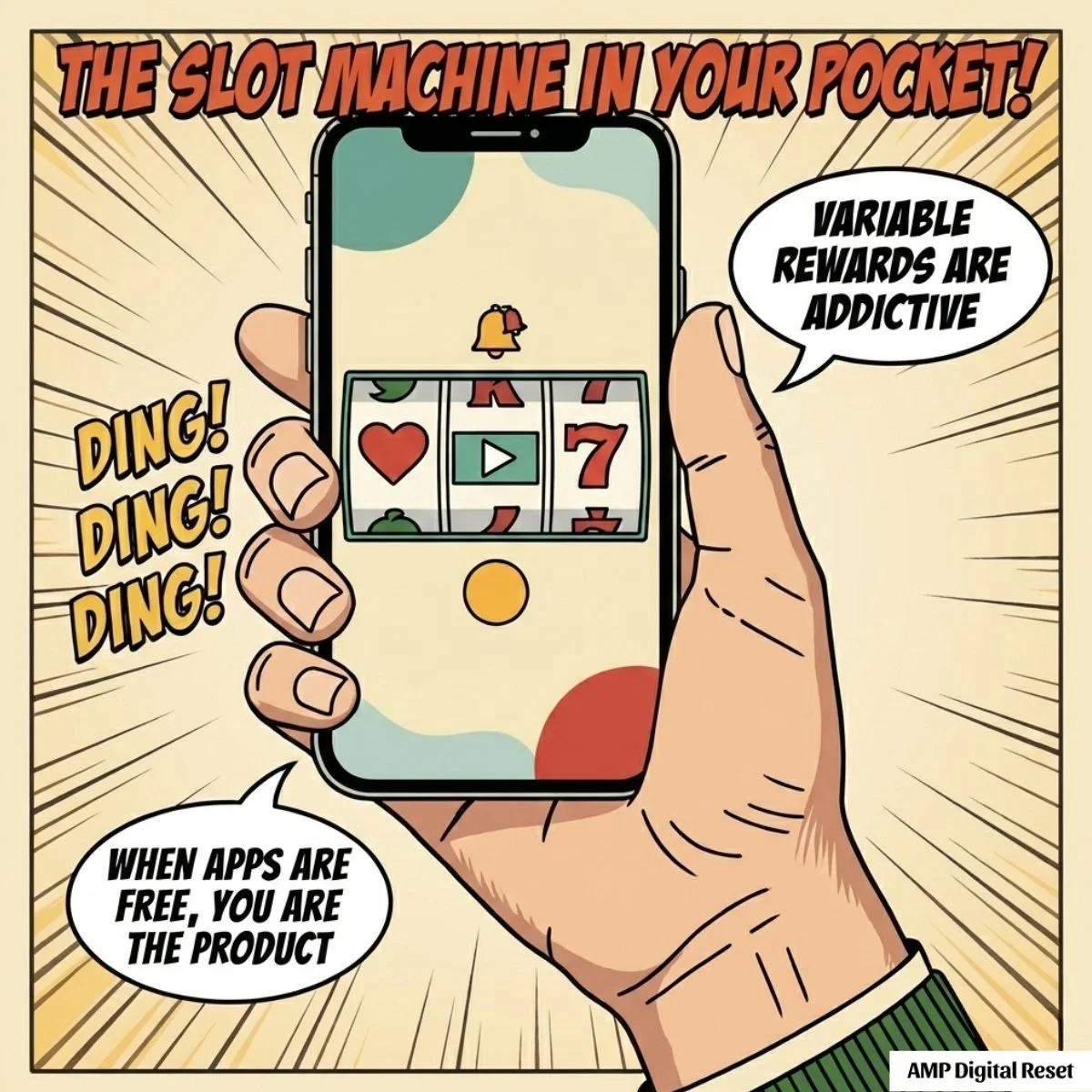
Slot machines don't pay out on every pull. They don't pay out on a predictable schedule either. They pay out randomly becasue that randomness is the entire mechanism. When a reward is unpredictable, the brain doesn't relax between attempts. It ramps up. It pays closer attention. It stays in the loop, waiting for the hit.
This is called variable-ratio reinforcement, and it produces the most compulsive behaviour of any reward structure ever studied in psychology. In lab research, rats pressed levers thousands of times chasing a random food pellet, while ignoring a lever that delivered a pellet every single time. Certainty is boring. Unpredictability is irresistible.
Our kids' brains are doing exactly the same thing when they:
Open a loot box and don't know what they'll get
Pull to refresh a social feed
Hit the spin button in a mobile game
Wait to see if their video gets views or likes
Roll for a new character in a gacha game
Keep watching YouTube to see if the next video is as good as the last one
The pull isn't "I want this." It's "I might get something amazing this time." That's a fundamentally different neurological state, and it's one that's nearly impossible to exit voluntarily, especially with a developing prefrontal cortex that won't fully mature until the mid-twenties.
This is why willpower doesn't work here. We can't willpower our way out of a slot machine loop. Casinos figured this out decades ago. App developers figured it out, too. Now we know it. The antidote isn't shame, it's structure. We set the done point before the loop starts, just as a sensible person sets a gambling budget before walking onto a casino floor.
Building a "Done Point"
Choose a clear, visible done point that our kids can predict and recognize it before they start. The goal is a stopping cue that exists outside the app, because most apps will not provide one.
Age-Specific Examples
Ages 2–4:
"When the timer sings, we park the iPad"
"Two episodes, then snack time"
Use a visual timer they can see counting down
Ages 5–7:
"Stop at the end of this episode or level"
"When the timer dings, we switch to outside time"
Let them help set the timer — ownership matters
Ages 8–10:
"Two rounds, then we close it"
"You can play until the timer, then we do the activity you chose"
Build in their input on timing (within reason)
Ages 11+:
"You have 30 minutes, you choose how to use it"
"Set your own timer and honor it"
Natural consequences: "If you can't stop when agreed, we take a break from this app"
The Script
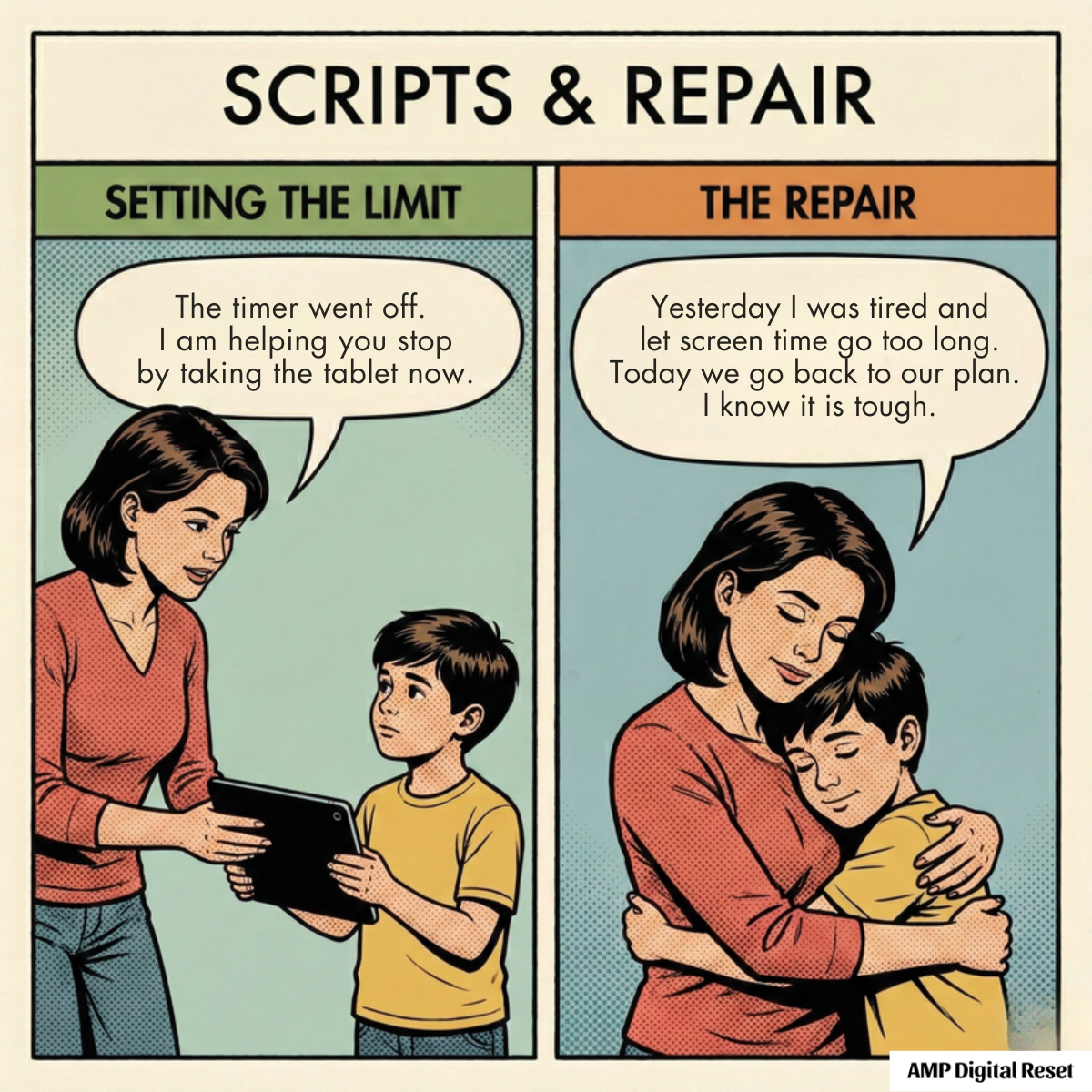
"I won't let infinite scroll take over your brain today. I know you want more. It's okay to be upset. We're still done."
Alternative scripts:
"This app is built like chips with a fishhook, and your brain will want 'just one more.' So we're choosing a done point now. When the timer dings, we're done."
"I know you're mad. Your brain is mad because it expected another hit of fun. That's how the app is designed. Let's help your brain calm down."
Then Help the Brain Cross the Bridge
Immediately transition to something regulating for the nervous system:
Water or a snack
Movement (jumping jacks, dancing, running outside)
Sensory play (LEGO, playdough, kinetic sand)
Music
A hug or physical connection
Pro tip: Have these ready before screen time ends. The boredom basket is within arm's reach, the water bottle is filled, the outdoor shoes are by the door.
Troubleshooting: "What If They Still Melt Down?"
They probably will. Especially the first few times we implement a done point.
What to do:
Hold the boundary: "I know you're upset. We're still done."
Name the feeling: "You're really disappointed. You wanted to keep playing."
Offer the bridge: "Let's get some water and go outside."
Don't negotiate: This teaches them that melting down works.
Validate later: "That was hard. Screen time can be really hard to stop. That's why we need rules."
It gets easier. After 3–5 consistent experiences, their brain learns the new pattern. Ours does too.
Digesting & Processing Content
Screens don't just take time; they take nervous system bandwidth. Kids often need help "digesting" what they watched, especially if it was intense or overstimulating.
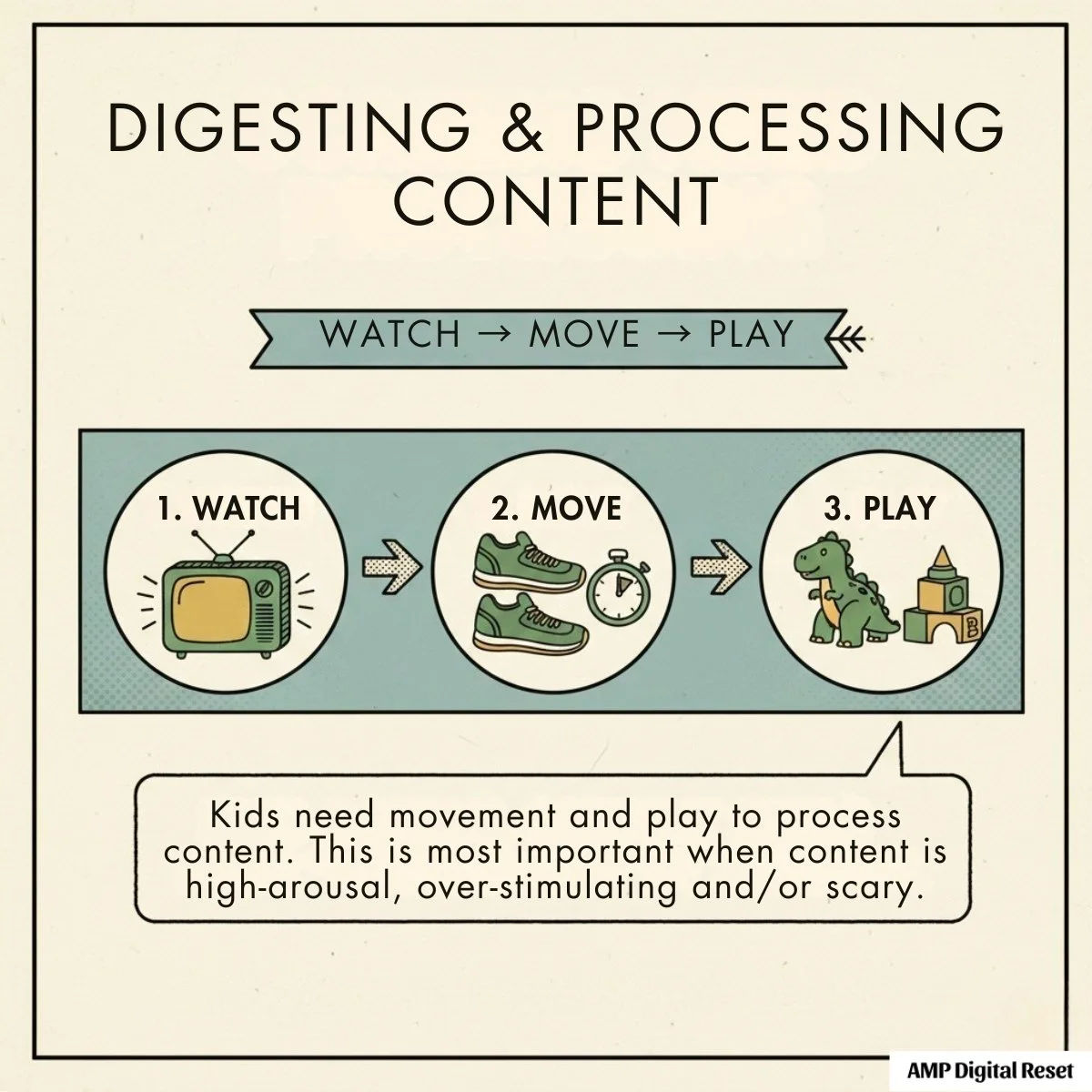
WATCH → MOVE → PLAY
The simplest recipe:
WATCH: They consume content
MOVE: Physical activity (even 5 minutes counts)
PLAY: Unstructured, creative play
Why this matters: Children can seem completely fine during a show and then melt down the moment it ends — their bodies are still processing what they absorbed. Transitioning with low-stakes activities like a snack, movement, outside time, LEGO, blocks, or playdough helps them shift gears and make sense of the content.
Make-believe play is an awesome way to process content. My kid will ask to “Play it Out” after we watch a movie with suspense or a villain. When we don’t “Play it Out”, it comes out in other ways.
Movement and Play is Important After:
High-action shows
Scary or intense content
Anything that ends on a cliffhanger
Compulsion-loop content
Boredom Is a Skill
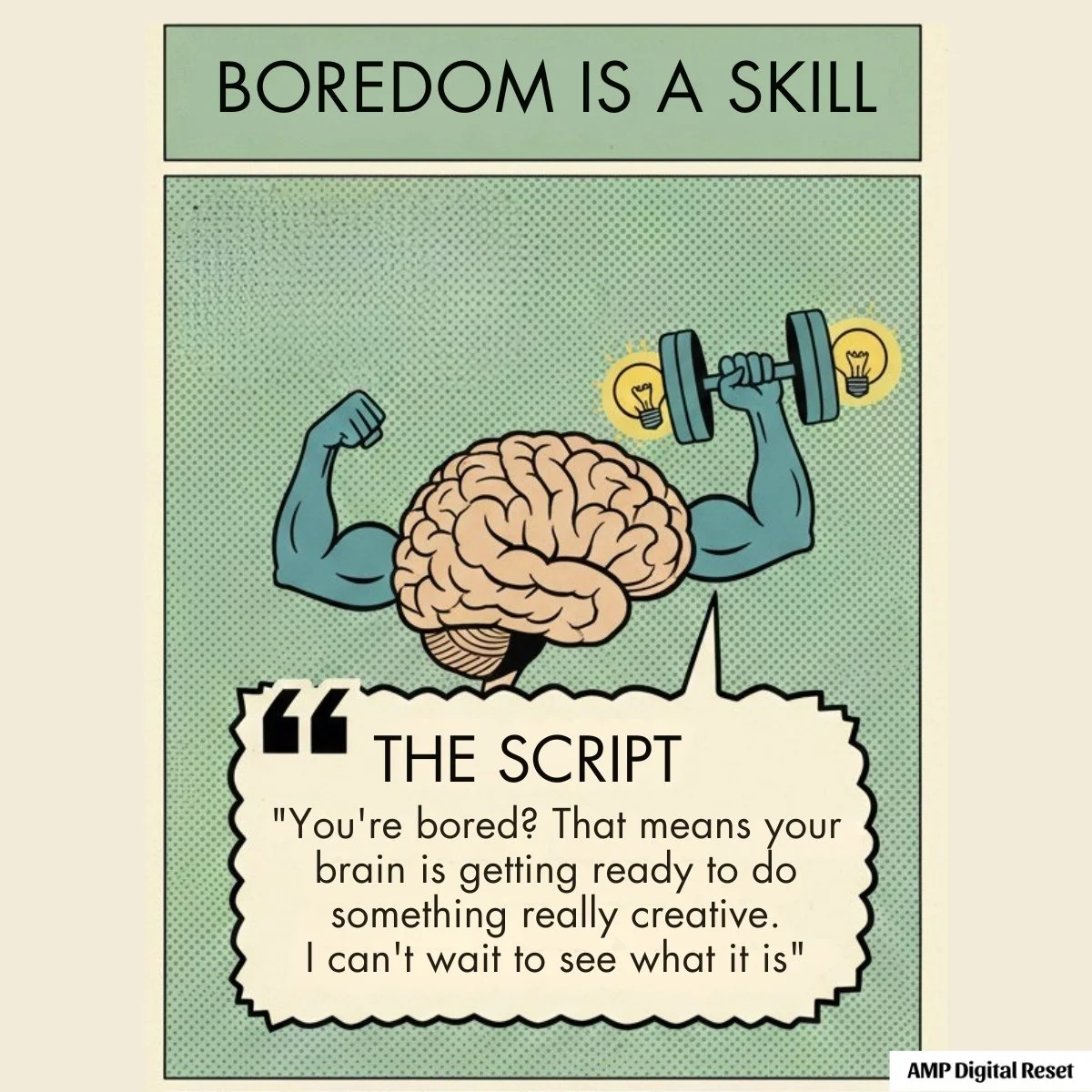
Every time we offer unstructured, low-stimulation time, we're giving the brain a chance to recalibrate, get creative, and increase its own tolerance for quiet, low-stimulation experiences.
The Script
"You're bored? That means your brain is getting ready to do something really creative. We can't wait to see what it is."
Why Boredom Matters
When our kids get regular low-stimulation time, their brains recalibrate — and creativity resurfaces. Boredom can trigger discomfort, and we rush to fix it to avoid the whining, the mess, the uncertainty. But boredom builds imagination, frustration tolerance, and the capacity for independent play.
Practical Idea
Keep a "Boredom Basket" nearby: paper, markers, LEGO, tape, cards, pipe cleaners, playdough.
Don't announce it. Just have it available. Let them discover it.
Why YouTube Is Less Safe Now
The internet is constantly evolving, and none of us got a user manual.
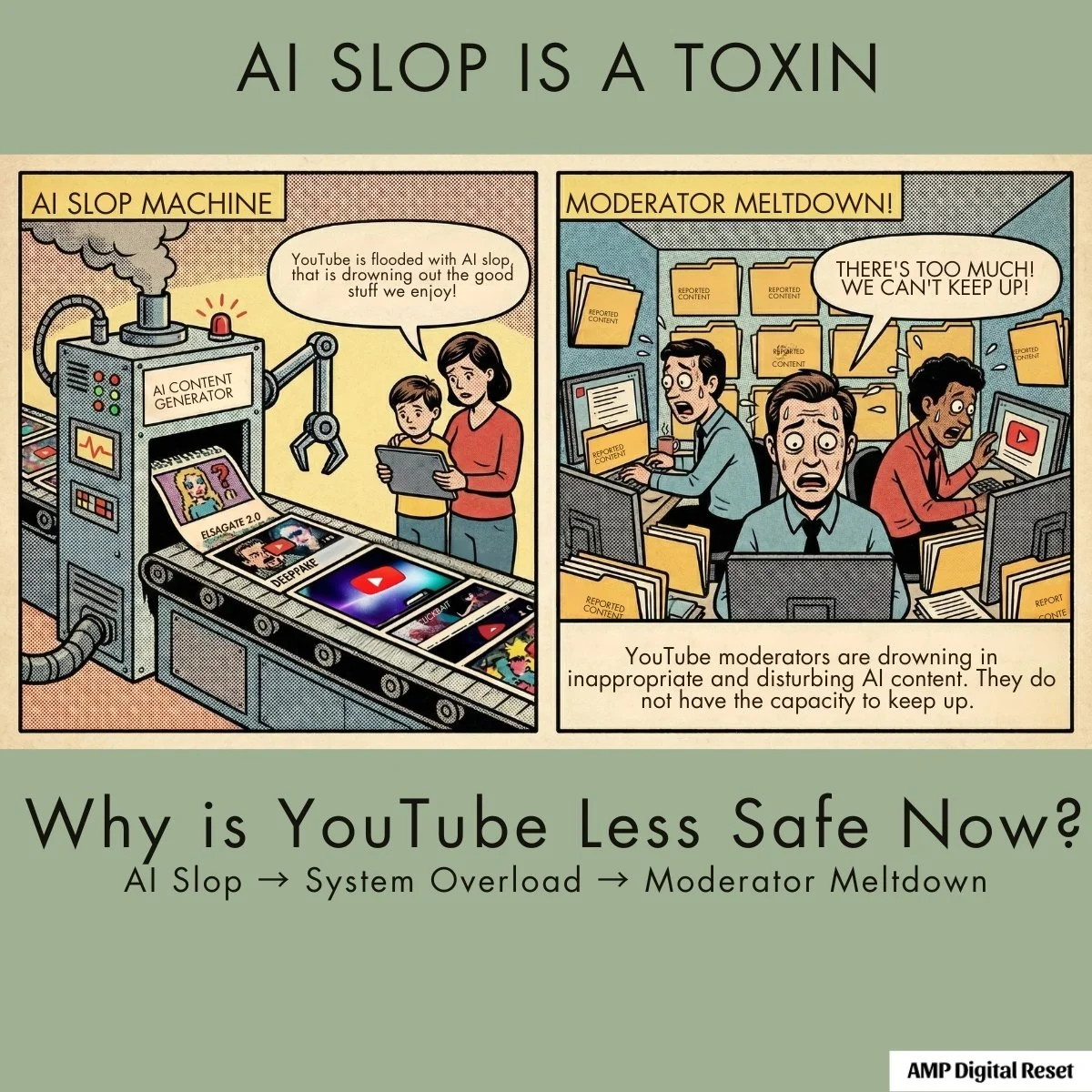
Many platforms are being flooded with AI-generated content: cheap, weird, and sometimes disturbing material pouring in faster than any moderation system can keep up with.
What this means for our families:
"Kid-friendly" is no longer a guarantee
YouTube's algorithm can pull kids from Bluey to something genuinely unsettling in just a few clicks
The safest screen time is curated, co-viewed, and time-bound
YouTube Kids improves safety but doesn't guarantee it — AI content leaks through moderation at scale
YouTube is currently not a safe option for kids to watch alone
This isn't fear or paranoia. It's awareness, and awareness is the whole game.
What to Do Instead
Option 1: Curated Playlists Only
Create playlists of approved content in advance
Turn off autoplay
Stay in the room
Use YouTube Kids with active supervision
Option 2: Use Alternative Platforms
PBS Kids Video app: Free, high-quality, no ads, no algorithm
Khan Academy Kids: Educational, curated, no rabbit holes
Kanopy App (FREEwith a library card!)
Disney+, Netflix Kids profiles: Curated libraries (still benefit from supervision)
Downloaded content: Buy or rent specific shows and keep them offline — no algorithm involved
Script for Talking to Other Caregivers
"We're taking a break from YouTube right now because of some safety concerns with AI content. Here are the shows and apps we're comfortable with: [list]. Thanks for understanding!"
Keep it simple. We don't need to convince anyone else. We're just protecting our own kid's media diet.
Co-Viewing: More Than Just Watching Together
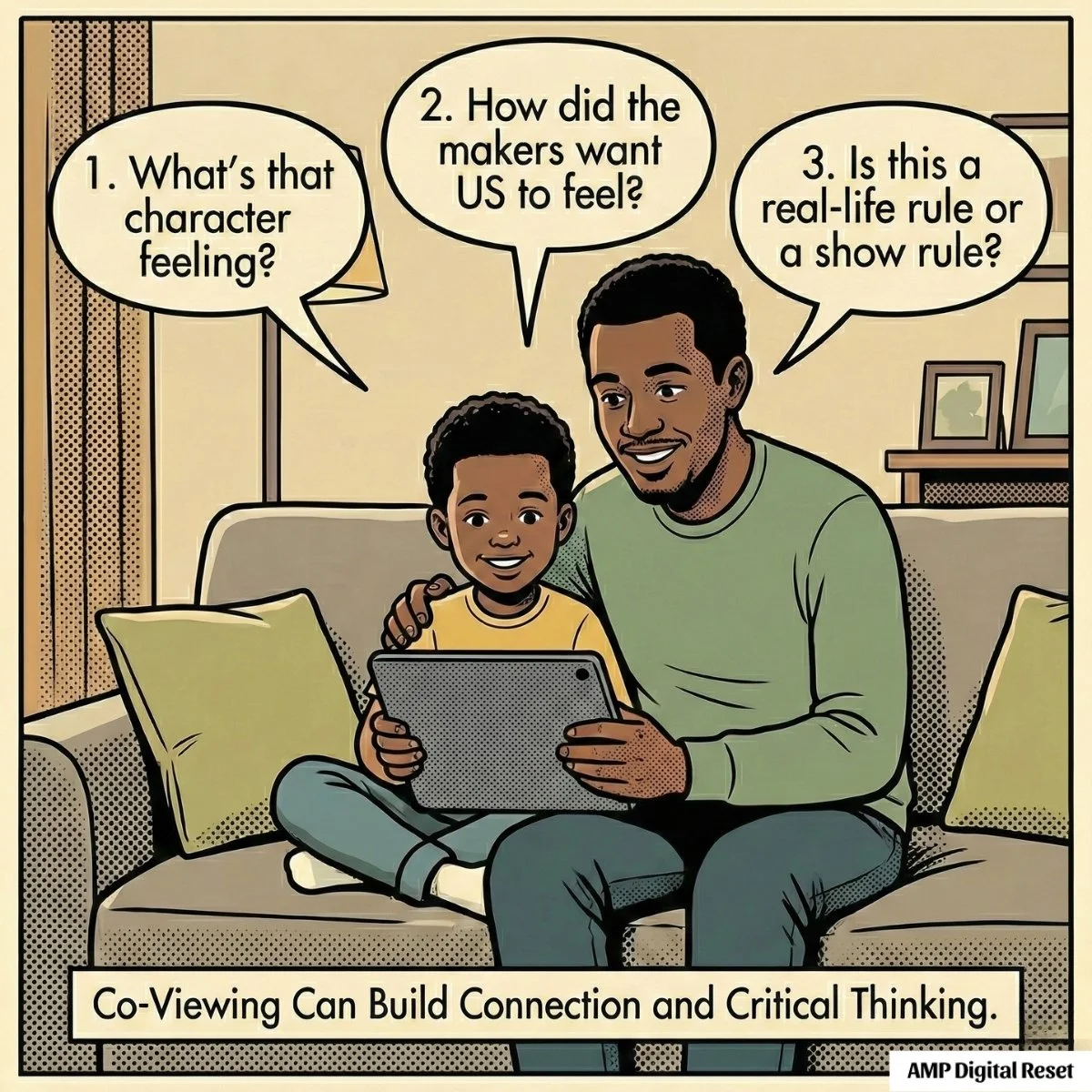
Children take cues from the adults they feel closest to. We can watch media alongside them whenever possible to connect with the stories and characters they love, and we build a pathway for real conversation.
Why It Matters
Co-viewing lowers secrecy, reduces power struggles, and turns passive watching into:
Emotional literacy (naming and understanding feelings)
Media literacy (spotting persuasion and manipulation)
Reality-testing ("show rules" vs. how real life works)
Questions to Ask While Co-Viewing
Ages 3–5:
"What's that character feeling?"
"How did that make you feel?"
"Is this pretend or real?"
Ages 6–8:
"How did the makers want us to feel?"
"Is this a real-life rule or a show rule?"
"What would you do differently?"
Ages 9–12:
"Who made this and why?"
"What are they trying to sell us?"
"Do you think this is realistic? Why or why not?"
"How does this compare to real life?"
The Long Game: Creating a Pathway for Hard Conversations
When we invest in co-viewing, connection, and open conversations about media, we're building a pathway. And we can return to that pathway when our kids encounter something disturbing or confusing.
They will see something — on a friend's phone, on a platform we thought was safe, in a corner of the internet we didn't know existed. If they process that stuff in isolation, it can cause real harm.
When children understand they can talk to a trusted adult about media, they develop critical thinking through those conversations. The habit of returning to safe, open dialogue can genuinely save lives.
What to Do If What We're Watching Together Is... Garbage.
It happens. We sit down to co-view, and five minutes in, it's clear this is not it.
Scripts:
"Hmm, I'm not loving this. What do you think?"
"This is kind of mean-spirited. Want to find something else?"
"I don't think this is what we thought it would be. Let's switch."
Let them weigh in. Sometimes they'll agree. Sometimes they won't. Either way, we're modelling critical thinking — which is exactly the point.
Our Own Screen Use
Yes, we're on our phones. And sometimes we let screen time go longer than we planned because we are tired, sick, or overwhelmed.
What actually matters:
Are we present during key connection moments? (Meals, pickup, bedtime)
Can we put it down when our kids need us?
Are we modelling "done points" for ourselves?
When the Phone Gets Us First
The same slot machine mechanics that make it hard for our kids to stop a YouTube spiral? They work on us too — arguably better, because our phones know our exact triggers. The news cycle, the group chat, the work email that wasn't urgent. We pick up the phone to check the weather and surface twenty minutes later, wondering what happened.
We're not bad parents. We got played by the same design. The move isn't shame — it's the catch. Notice it, name it out loud, put it down. That's the whole thing. And when we do it in front of our kids, we're teaching them something no screen time rule ever could: that we're all in this together, and we can choose to put it down.
The "Caught Myself" Script — say it out loud, in front of them:
"Oh no. I did it again. I picked up my phone to check the time and now I'm reading about why pandas are bad at being pregnant. The phone got me. Classic phone. Putting it down now — where were we?"
The self-deprecating specificity is the whole move. Kids find it genuinely funny, it breaks any tension in the room, and it still names the mechanism without turning into a lecture. A few variations depending on your kid:
Little kids: "The phone tricked me! Did you see that? It tricked me. Sneaky phone." (Put it face down with a little dramatic flair. They'll love it.)
Middle kids: "Okay, I got sucked in. I went in for the weather and came out knowing too much about micro-plastics. Classic trap. I'm back."
Tweens: "Don't say anything. I know. The algorithm got me. I'm putting it down before it takes me somewhere worse."
Simple Self-Audit
For one day, just notice:
When do I reach for my phone?
What am I using it for?
Am I using it to avoid something?
How do I feel after a scrolling session?
Then pick one small change:
Phone in another room during dinner
No scrolling before coffee
Set a personal "done point" for social media
Scripts for the Hard Moments
When They Beg for "Just One More"
"I know you want more. The answer is still no. Your brain is doing exactly what it's designed to do — wanting more dopamine hits. But we're the grown-ups in this house, and we're protecting your brain."
When They Compare to Other Kids
"Every family has different rules. In our family, this is our rule because [brief reason]. I'm not saying their family is wrong — I'm saying this is what works for us."
When We Need to Change a Rule
"I learned some new information about [YouTube/this app/screen time], and we're going to make a change. I know this is frustrating. Here's what's going to happen instead: [alternative]."
When They Sneak Screen Time
"You broke our agreement. I understand the pull is strong — these apps are designed to be irresistible. But the consequence is [loss of device for X time]. We'll try again in [timeframe], and I'll help you be more successful."
When We're Too Tired to Enforce
Script (to ourselves): "It's okay to have an off day. Tomorrow we reset. One imperfect day doesn't undo all the good boundaries we usually hold."
Script (to them): "Today is a different day. We're having extra screen time because [reason]. Tomorrow we're back to our normal rules."
When Another Parent Judges Us
"Thanks for your input. We're figuring out what works for our family."
Then change the subject. We don't owe anyone an explanation.
The Bottom Line
Navigating screen time in today's digital world can feel overwhelming. But we're not doing it alone, and we don't have to get it perfect.
By understanding the different types of content, the context in which it's consumed, and the design elements that make some media nearly impossible to stop, we can make more informed decisions together.
It's not about eliminating screen time. It's about building a balanced, healthy digital diet. By labelling content, setting clear boundaries, co-viewing, and building done points, we can create a more meaningful and less stressful relationship with technology in our homes.
Be patient with ourselves and our kids as we put these changes into practice. Building new habits takes time, and the journey will have its ups and downs. With each small step, we're helping our children develop the skills they'll need to navigate the digital world confidently, just as Saturday morning cartoons once had a beginning, a middle, and an end.
We've got this!
Thank you for reading! If this post helped you:
Option 1: Share this with one parent who needs it.
Do you know someone who would enjoy being equipped with this information? Send them this post! Share it in your parent groups. Forward it to your child's teacher.
Together, we can help more families find balance, connection, and peace around screens.
Option 2: Become a Supporter
About This Project
I was one of the first social media specialists in Canada. I sat in the rooms where persuasive technology was designed to manipulate you and your kids.
Then I became a teacher because I wanted to be part of the solution. Now I teach high school, where I see the impact of persuasive technology on kids every day. I work hard to equip students with the tools to navigate the digital world thoughtfully and carefully.
AMP Digital Reset is what I do on my own time: workshops and resources that help parents make informed decisions.
Your donation helps keep this project sustainable.
👉 Support AMP Digital Reset
Option 3: Book a Workshop
We create digital safety workshops for schools, organizations and groups of parents. Our workshops are customized to address concerns most relevant to your group. Workshops can be delivered online or in-person.