The Blanket Fort Series Ch.1
Screen Time Without the Battles
Dear Parent,
If screen time ends in battles at your house, you're not failing. You're up against content that was built by some of the best engineers on the planet and designed to be impossible to stop. That's not a theory. I spent years inside the persuasive technology industry before working in education and becoming a parent.
From the boardrooms of marketing agencies to high school classrooms to my own living room, I've been immersed in how this content is created, how it impacts learning, and how it impacts families. You deserve to know what you're actually up against, and this guide is my attempt to hand you exactly that.
If you want to eliminate all screen time, we're probably not your people, but we get it. This was created for parents who look forward to watching cartoons in their pyjamas from a blanket fort. It's for parents who know that sometimes we need to give ourselves a time-out because we're exhausted and irritable... and a few episodes of Bluey are better than snapping at our kids.
This is also for parents who want to understand how content impacts our kids, so we can prevent the long-term developmental issues and the short-term nightmare when screen time ends.
This isn't about bad parenting or weak willpower. It's about understanding what we're up against, so we can stop blaming ourselves and start building better systems.
Here's a simple way to think about it before we go deeper.
Some screen time is like soup: cozy, nourishing, and it can improve the whole vibe in the house.
Some screen time is like chips: enjoyable until it becomes a recurring negotiation.
Some screen time is like neon-blue mystery slush: exciting at first, but it leads to chaos when the high crashes.
The 3 Levers
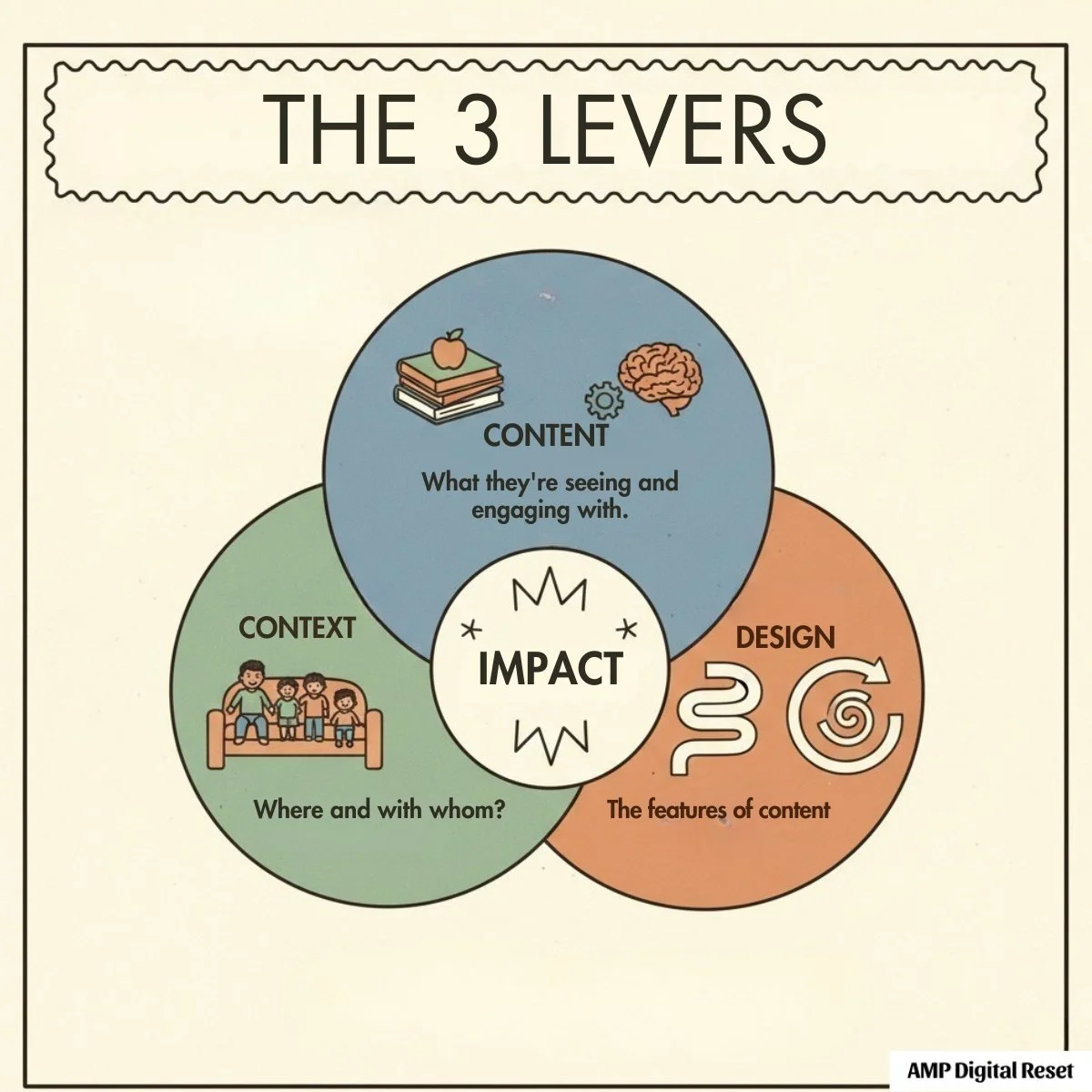
What if managing screen time was less about rules and more about understanding? That's exactly what the 3 Levers are for.
1. CONTENT: What are they consuming?
Not all screen time affects the brain the same way.
2. CONTEXT: Where and with whom?
Side-by-side interactions beat solo. Shared spaces beat bedrooms. Adult presence changes everything.
3. DESIGN: Does it have an end, or does it hook?
Features like autoplay, infinite scroll, and streaks aren't neutral. They're designed to keep users hooked, and they work on adult brains too.
Screen Time Nutrition Labels
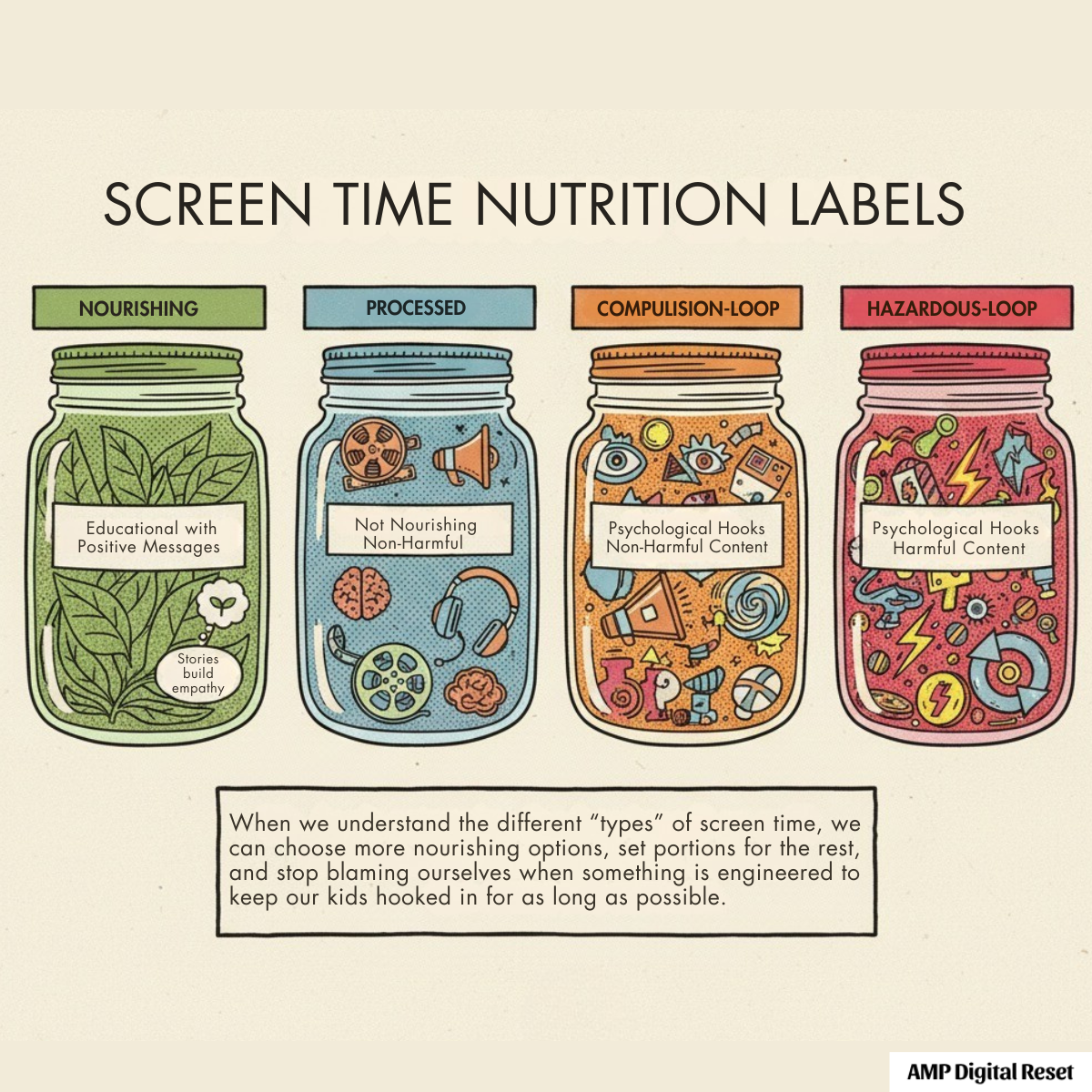
What if you could read a screen the way you read a nutrition label? That's exactly the idea behind Screen Time Nutrition Labels: discern and label first, then decide on portions.
🟢 NOURISHING: The good stuff. Easy to stop, good for everyone
What it is: Creative, educational, connecting, pro-social. Often easier to stop. It’s the stuff that feels good during and after.
Examples:
Educational shows with clear narrative arcs: Bluey, Daniel Tiger, Sesame Street, Cyberchase, Nature Shows, Wild Kratts, Quality movies with narrative arcs and dynamic characters.
PBS Kids content generally (no ads, no algorithm, no autoplay rabbit holes). Often created by teams of educators.
Nature documentaries. If they are not specifically designed for kids, make sure they aren’t too scary.
Video calls with grandparents, cousins, pen pals, especially when there's a shared activity like drawing together.
Creative tools: Procreate for kids, GarageBand, stop-motion apps, Scratch Jr.
Goal-oriented learning apps with natural stopping points: Typing Club, Khan Academy Kids.
Co-op games with clear endpoints where kids play alongside (not against) a parent.
Many cartoons from the 80s and 90s are not engineered to hook in viewers and are easier to stop.
Portion guidance: Generous. These build skills, emotional literacy, and real-world connections.
🔵 PROCESSED: Fine in moderation. Not harmful, but not building much either.
What it is: Not deeply nourishing, not harmful. Needs structure and portioning. Can leave kids dysregulated, especially when they're tired, hungry, lonely, or having an off day.
Examples:
High-stimulus cartoons that are entertaining but not building much: SpongeBob, The Loud House, Teen Titans Go! Paw Patrol
Minecraft in creative mode (lower stakes than survival or multiplayer)
Unboxing channels and kid reaction content on YouTube Kids (entertaining, limited nutritional value)
Portion guidance: Set clear time limits. Use timers. Follow with movement and play.
Watch for: Dysregulation at transition times. If our kids are crankier after watching, it's a sign this content is harder for them to digest.
🟠 COMPULSION-LOOP: Hard to stop by design. Keeps kids in the loop.
What it is: This content is hard to stop due to design and business models. Many platforms use sophisticated techniques (borrowed directly from casino psychology) to keep users engaged. Features like infinite scroll and autoplay maximize time on the platform. These aren't side effects of the design. They are the intentional design.
Examples:
YouTube (algorithm-driven, autoplay, constant novelty)
YouTube Shorts (this format is significantly more difficult to stop than long-form)
Minecraft survival mode and multiplayer servers (progression systems, social pressure, no natural end)
Games like Fortnite. These games feature variable outcomes every round, and social peer pressure is built in
Roblox, especially with its in-game economy and social elements
Mario Kart, Mario Party, and similar Nintendo titles. These are fun and positive, but "one more race" is a real loop
Many free-to-play mobile games with in-app purchases
Apps with "streaks" (daily login bonuses and incentives). This is classic operant conditioning
Snapchat, where streaks and social approval are combined as the variable reward
Social media feeds of any kind, especially Instagram and TikTok
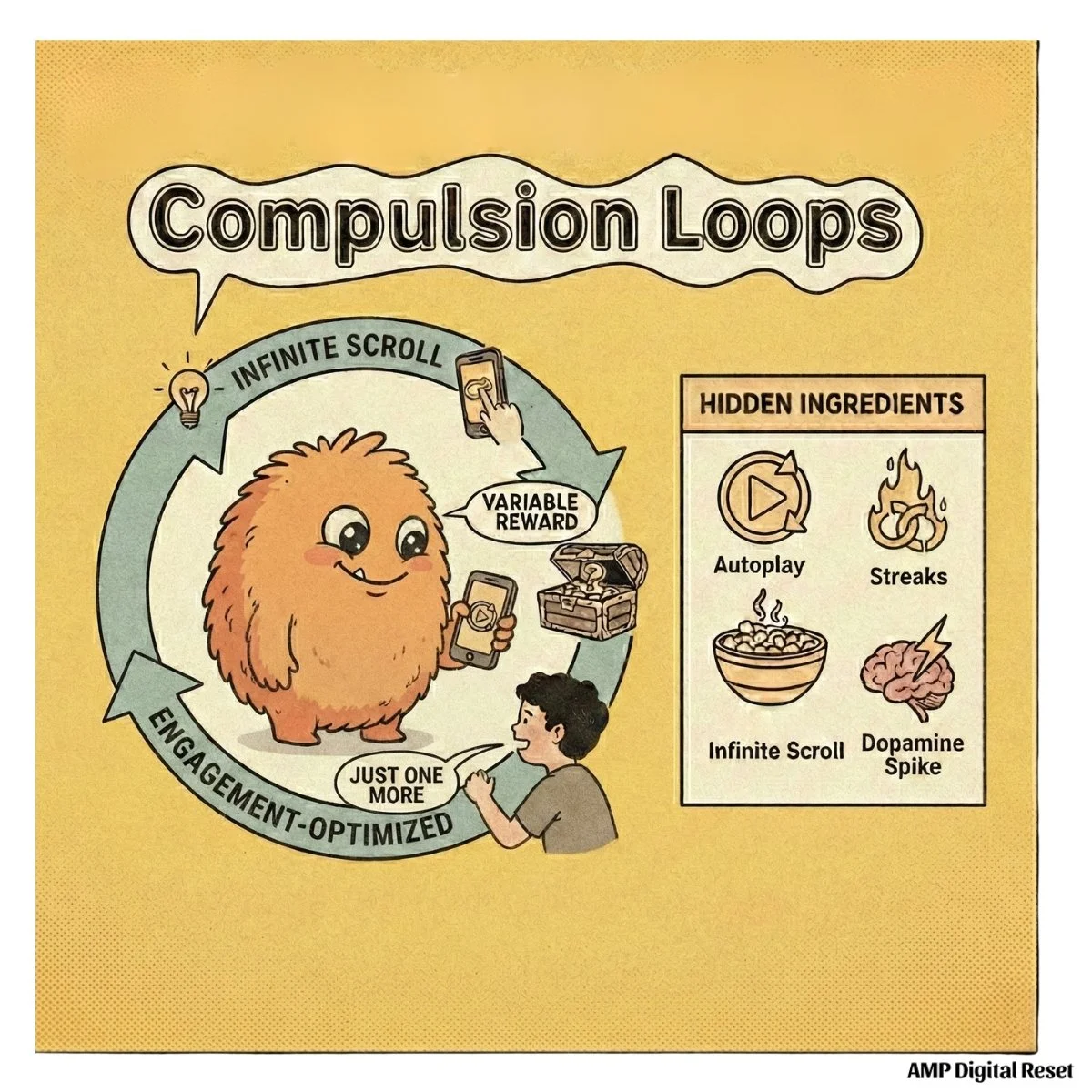
Hidden ingredients to watch for:
Autoplay (no natural stopping cues)
Infinite scroll (no "done" point ever)
Streaks (fear of losing progress)
Variable rewards (slot-machine effect)
Loot boxes and random rewards
Daily login bonuses that punish absence
Constant novelty (big feelings, quick hits, immediate next thing)
Portion guidance: Restricted or avoided for young kids. If allowed, it requires adult-set "done points", parental controls for safety, and co-viewing.
🔴 HAZARDOUS-LOOP: Psychological hooks plus harmful content. No safe portion.
What it is: When platforms designed to hook us also contain misinformation, disinformation, or disturbing material, the psychological impact can be significant. The hook keeps kids in contact with harmful content longer than they'd ever choose to be. Sometimes disturbing content creates a hook because kids are naturally curious and want to understand what they are seeing.
Examples:
Unsupervised YouTube - algorithms can pull kids from Bluey to something deeply disturbing in a few clicks. Moderators cannot keep up with the flood of AI slop right now.
Apps, platforms and social media with user-generated content. AI slop is currently flooding these spaces.
Unsupervised Discord servers featuring unmoderated content, combined with real social bonds. Cases of inappropriate interactions with strangers are ongoing.
Violent or age-inappropriate games.
Any platform combining psychological hooks with harmful material
Instagram, Facebook, Snapchat, TikTok, etc., have repeatedly faced legal issues due to their inability to protect kids from disturbing people and content. Their “safety” features continue to fail, and kids will see violence, dead bodies, nudity and graphic content. Cases of inappropriate interactions with strangers are ongoing.
Portion guidance: Eliminate. There is no safe portion.
The Compulsion Loop Problem
It's not a lack of discipline. It's an engineered design. Here's the science behind why screens are so hard to put down.
1. Persuasive technology floods the brain with "keep going" signals - Many games and cartoons incorporate rapid scene changes, constant novelty, and frequent mini-rewards. Dopamine spikes trigger the brain to keep reaching for more.
Basically: "Ooh, that felt good… do it again."
2. Variable rewards are especially sticky - Variable rewards mean your child might get something exciting on the next scroll, next loot box, or next level. The brain doesn't know when the reward is coming — so it never fully disengages. It ramps up attention and stays in the loop, waiting.
Basically: "Ooh, that was better than expected…do it again."
3. Stopping can feel like something is being taken away - When the brain is anticipating the next hit of novelty and gets cut off, some kids respond with irritability, restlessness, or full meltdowns. This is a genuine withdrawal-like response, not a character flaw.
Important: Tantrums and meltdowns are a natural part of development and can happen at any time — the incorrectly cut banana is a founding document of parenthood. Compulsion loops don't cause meltdowns. They exacerbate them.
"Just One More" Is Slot Machine Psychology
Here's something that changed everything for us: the apps and games our kids are using were designed using the same behavioural science that optimised Las Vegas slot machines.
Slot machines don't pay out on every pull. They don't pay out on a predictable schedule either. They pay out randomly because that randomness is the entire mechanism. When a reward is unpredictable, the brain doesn't relax between attempts. It ramps up. It pays closer attention. It stays in the loop, waiting for the hit.
This is called variable-ratio reinforcement, and it produces the most compulsive behaviour of any reward structure ever studied in psychology. In lab research, rats pressed levers thousands of times chasing a random food pellet, while ignoring a lever that delivered a pellet every single time. Certainty is boring. Unpredictability is irresistible.
Our kids' brains are doing the same thing when they:
Open a loot box and don't know what they'll get
Pull to refresh a social feed
Wait to see if their video gets views or likes
Keep watching YouTube to see if the next video is as good as the last one
The pull isn't "I want this." It's "I might get something amazing this time." That's a fundamentally different neurological state and one that's nearly impossible to exit voluntarily, especially with a developing prefrontal cortex that won't fully mature until the mid-twenties.
Willpower doesn't work here. We can't willpower our way out of a slot machine loop. Casinos figured this out decades ago. App developers figured it out, too.
The Done Point
The good news is that understanding the loop is already most of the battle. Once you see it clearly, you stop blaming yourself and your child, and you start building structure instead.
The antidote isn't shame. It's a done point: a clear, visible stopping cue that exists outside the app set before the session begins. Most apps will never provide one. So we do.
Chapter 2 goes deeper into the exact scripts, the age-specific strategies, what to do when things fall apart, and how to help the nervous system land somewhere safe after screens end.